
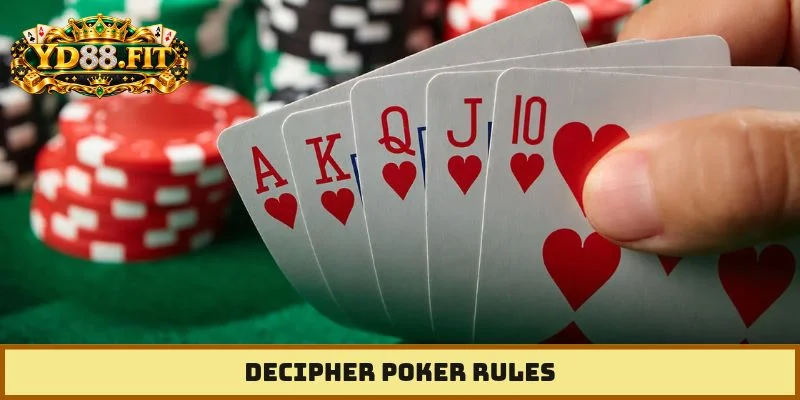
Poker rules guide players to master professional strategies to elevate their winning rate in every intense match. Top-tier experts frequently share smart analysis secrets to optimize profit efficiency through each round of play. Participants can easily verify their skills at YD88 com with an exceptionally high-class and modern system.
Details of poker rules at a standard gaming table
Each Poker rules match utilizes a standard fifty-two-card deck with two to ten participating positions seated around the table. At the start of the game, the two players sitting to the left of the dealer position are required to post small and big blinds to create the initial prize pool.
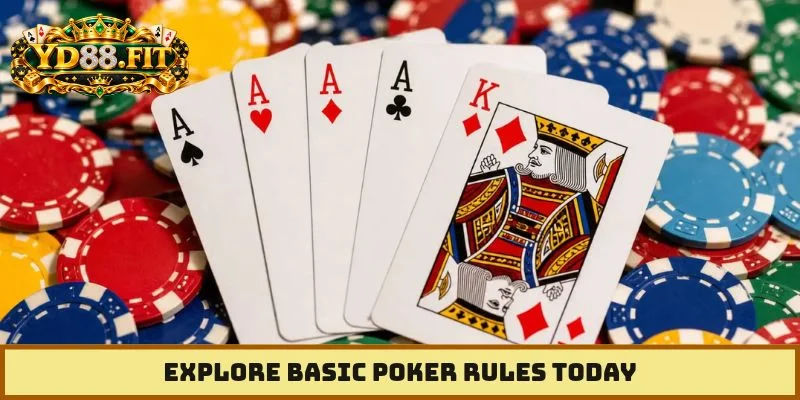
Afterward, each person receives two hole cards dealt face down so that only they can see them. Through four dramatic rounds consisting of Pre-Flop, Flop, Turn, and River, five community cards are successively turned face up in the middle of the table. The core task is to combine the two hole cards with the five community cards to form the strongest five-card hand.
| Ranking | Hand name | Combination description |
| 1 | Royal Flush | Five consecutive cards of the same suit from 10 to Ace |
| 2 | Four of a Kind | Four cards sharing the same numerical value |
| 3 | Full House | A combination of three matching cards and a pair |
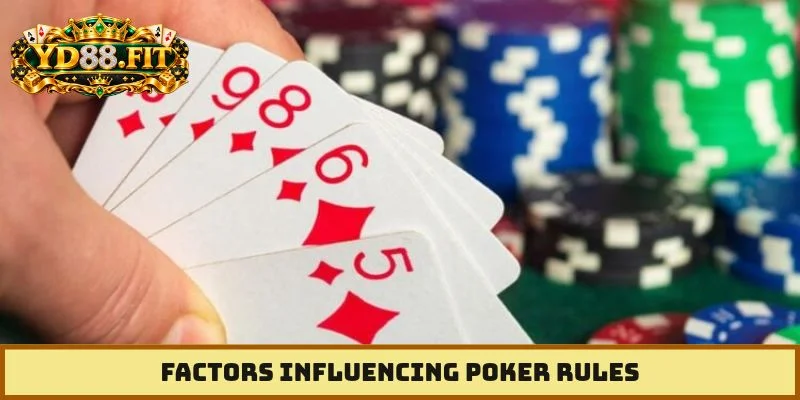
| 4 | Flush | Five cards of the same suit without needing to be consecutive |
| 5 | Straight | Five consecutive cards of different suits |
Betting actions in modern poker rules
Poker specifically regulates the right to choose an action at each turn to maintain fairness and transparency throughout the match. Understanding the meaning of each operation helps control bankroll effectively, preventing players from falling into psychological traps when facing heavy pressure.
- Fold is the decision to refuse to continue pursuing the match when realizing that the hole cards are too weak with no chance of improvement in the following round. The person executing this action accepts losing all money previously contributed to the common pool and waits for a new game.
- Call occurs when the preceding player has set a specific money amount, and a subsequent player wishing to continue accompanying must put out an amount of money exactly equal to that figure. This action demonstrates a certain level of confidence in the strength of the hand combination currently held in hand.
- Raise is the strategy of increasing the money amount higher than the preceding player to exert psychological pressure or increase the value of the prize pool. This technique is usually applied when holding a strong link or wanting to execute a sophisticated bluffing trick.
- All-in means committing all current chips on the table into a single, highly risky and dramatic bet. This situation typically appears during the decisive late stage of the game when both parties are certain they hold an unbeatable hand.
Factors determining victory or defeat according to poker rules
Alongside adhering to basic gameplay laws, the ability to win long-term depends heavily on statistical probability analysis skills. Cultivating sharp logical thinking combined with subtle observation creates an overwhelming advantage on every gaming table.
Read more: Dragon Tiger – Experience The Ultimate Betting Atmosphere
- The seating position at the table directly impacts the amount of information collected before making the final action decision. The late position in a round always holds a major advantage thanks to observing the complete attitude and betting amounts of the entire gaming table beforehand.
- Smart bankroll management requires dividing capital into multiple reasonable small parts, absolutely avoiding dumping all money into a single table. This disciplined principle protects the account safely against unexpected fluctuations, maintaining long-term emotional stability.
- The ability to calculate the probability of necessary card appearances in the next round determines the correctness of calling actions. Individuals proficient in probability mathematics always know precisely when to stop at the right moment to optimize net profit.
- Firm emotional control prevents rashness and frustration leading to erroneous decisions after a string of unexpected consecutive losses. Keeping a cool head in every circumstance helps maintain peak form and thoroughly exploit vulnerabilities from opponents nearby.
Common mistakes to avoid when applying poker rules
Even when memorizing the theory by heart, many individuals still commit basic mistakes that severely diminish competitive performance. Early identification of the bad habits listed below will pave the way for extraordinary improvements in situational handling skills.

Ignoring the table seating position advantage
Neglecting action position is a major loophole when applying real-world Poker rules. Instead of merely comparing direct point scores like in the Dragon Tiger game, sitting in a later position provides the advantage of observing opponents’ actions before committing money. Acting hastily in early table positions with a weak hand often forces players into a passive stance and makes them easily exploitable by adversaries.
Over-betting with mediocre pocket cards
Raising bet levels emotionally violates the core safety principles of modern Poker rules. Many players place excessive confidence in small pairs or two suited cards while forgetting the risk of being outmatched in subsequent rounds. Temporary excitement obscures probability calculation capabilities, causing chips to drain rapidly against patient opponents waiting for genuinely strong hands.
Acting out of turn and exposing tactical information
Placing chips or folding before your turn is a basic technical error but very common in casino Poker rules. This inattentive behavior accidentally reveals folding or calling intentions, allowing subsequent opponents to seize the advantage. Maintaining a meticulous observation rhythm of the action rotation preserves the mystery of your hand, preventing opponents from reading your tabletop strategy.
Calculating pot odds incorrectly before calling
Deciding to add chips to chase a straight or flush draw without considering the prize pool size goes against accurate Poker rules thinking. If the required amount to contribute is significantly larger than the probability of the desired card appearing, that investment will inevitably result in long-term losses. Applying expected value percentage calculations supports making rational choices to call or fold.
Overusing bluffing strategies too frequently
Attempting to force opponents to fold using consecutive heavy bets is a double-edged sword when applying practical Poker rules. Experienced adversaries will quickly recognize abnormal bluffing frequencies and readily catch your bluffs holding medium hands. Bluffing tactics only yield maximum performance when harmoniously combined with tight gameplay and selecting correct target subjects on the table.
Conclusion
Poker rules serve as the core foundation helping strategy enthusiasts master gameplay with sharpness and bold skill. Anyone looking to elevate their valuation thinking skills needs to accurately grasp each technique throughout this supreme intellectual battle. YD88 always warmly welcomes masters to visit and test their skills against the most thrilling tables today. Join this professional gaming room immediately to claim grand rewards.
